How to Use the Semester Grade Calculator
Semester Grade Calculator handles both simple college schedules and complex high school weightings. You only have to follow three basic steps.
1. Select Your Grading Scale

The first step is telling the calculator if your school adds bonus points for advanced classes like AP or Honors.
Select the GPA Type switch at the top. You have two options here:
- Unweighted: Use this for standard college courses. An "A" is always worth 4.0 points.
- Weighted: Use this for High School AP, IB, or Honors classes.
This setting changes the math. In Weighted Mode, the calculator adds "bonus points" to your Quality Points based on the difficulty of the class.
| Course Type | Bonus Points | Example "A" Value |
|---|---|---|
| Regular / College | +0.0 | 4.0 |
| Honors | +0.5 | 4.5 |
| AP / IB | +1.0 | 5.0 |
2. Input Your Course Data
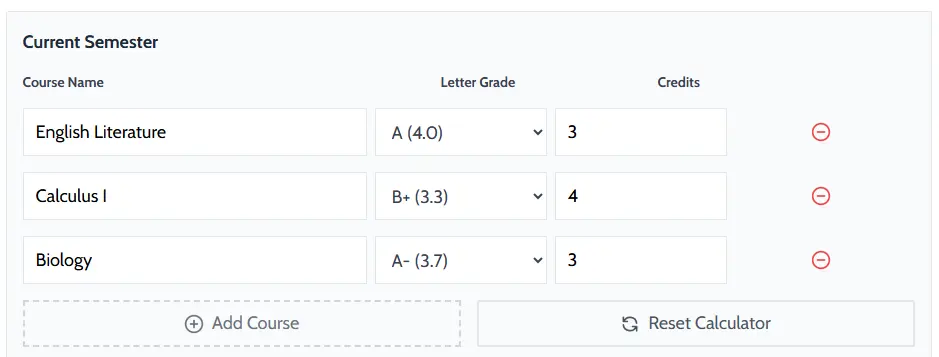
To get an accurate result, you must enter the correct Credit Hours (weight) and Course Type for every single class.
You have to add three data points for your every class.
- 1Letter Grade: Select your current standing (A+ through F) from the dropdown.
- 2Credits: Enter how much the class "weighs." (Standard college classes are usually 3 credits, while Lab Sciences are 4 credits).
- 3Course Type: (Weighted Mode only) Select Regular, Honors, or AP to apply the correct difficulty bonus.
Note: The most common user error we see is students leaving the default "3 Credits" for a 1-credit Elective, which falsely inflates their projected GPA.
3. Results

The calculator instantly displays your semester GPA, total quality points, and academic standing to help you understand your current performance.
Once you enter your data, the tool calculates two key metrics instantly:
- Quality Points: The total raw value you earned this semester.
- Academic Standing: A quick indicator of your performance (e.g., "Good," "Excellent," or "Probation Risk").
Pro Tip: Use the "Share Your Results" button. This generates a live link you can send to your academic advisor or parents to prove you are on track.
What is a Semester Grade? (Sessional GPA)
Most students confuse a Class Grade with a Semester Grade. They sound similar. But they measure completely different things. Here is the difference:
- Class Grade: The weighted average of your homework, midterms, and finals for one specific subject (e.g., Biology 101).
- Semester Grade: The average performance of all your classes combined for a specific term (e.g., Fall 2024).
Registrars and colleges technically call this your Sessional GPA. This distinction is critical (in most cases).
Your Class Grade determines if you pass a specific subject. But your Semester Grade determines your immediate academic safety.
Sessional vs. Cumulative GPA
You also need to know the difference between your "Sprint" and your "Marathon" numbers.
| Feature | Sessional GPA (Semester) | Cumulative GPA (Overall) |
|---|---|---|
| Timeframe | Single Term (e.g., Fall only) | All Terms (Total History) |
| Volatility | High (Change is easy) | Low (Hard to move) |
| Primary Use | Dean's List Eligibility | Graduation / Honors |
| Risk Factor | Triggers Academic Probation | Triggers Dismissal |
Registrars typically use the Sessional metric to flag students for probation immediately after December or May exams, even if their historical average is still decent.
If you are calculating this to see if you made the Honor Roll, you are looking for your Sessional GPA.
Next, let's look at the specific formula used to calculate it.
How to Calculate Semester GPA
The math behind your semester grade is standardized across North American universities. It relies on a single, universal formula:
Semester GPA = Total Quality Points ÷ Total Credit Hours
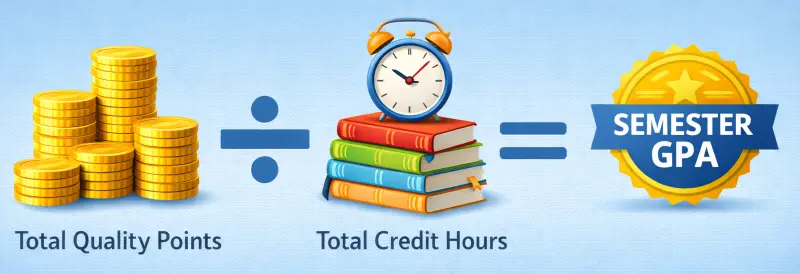
You cannot just average your letter grades. You must use this standard formula that accounts for the "weight" (credits) of each class.
To solve this manually, you cannot just average your letters (e.g., A + B / 2). You must follow a strict 3-Step Process to convert, multiply, and divide.
Step 1: Convert Letters to "Quality Points"
First, you need to turn your letter grade into a numerical value. If you are unsure of the basics, review how to calculate your GPA on a 4.0 scale to understand the industry standard.
Here is the standard conversion table used by the College Board:
| Letter Grade | Percentage Range | Quality Points (4.0 Scale) |
|---|---|---|
| A | 93 - 100% | 4.0 |
| A- | 90 - 92% | 3.7 |
| B+ | 87 - 89% | 3.3 |
| B | 83 - 86% | 3.0 |
| C+ | 77 - 79% | 2.3 |
| C | 73 - 76% | 2.0 |
| D | 60 - 69% | 1.0 |
| F | 0 - 59% | 0.0 |
Step 2: Multiply by Credit Hours
This is where most students get the math wrong. You must weight the grade by the Credit Hours. Think of Credit Hours as the "Multiplier."
- A in Chemistry (4 Credits): 4.0 × 4 = 16.0 Points.
- A in Gym (1 Credit): 4.0 × 1 = 4.0 Points.
We consistently observe that students overestimate their GPA because they treat a 1-credit elective "A" as equal to a 4-credit major course "A."
Step 3: Divide by Total Credits
Finally, you take your Total Quality Points and divide them by your Total Credit Hours. Here is a real-world example of a typical semester:
| Course | Letter Grade | Grade Value | Credits | Quality Points (Value x Credits) |
|---|---|---|---|---|
| Biology 101 | B | 3.0 | 4 | 12.0 |
| History 200 | A | 4.0 | 3 | 12.0 |
| English 105 | C | 2.0 | 3 | 6.0 |
| Lab Safety | A | 4.0 | 1 | 4.0 |
| TOTALS | 11 | 34.0 |
The Calculation:
34.0 (Quality Points) ÷ 11 (Credits) = 3.09 GPA
If you had just averaged the four grades (3.0, 4.0, 2.0, 4.0), you would have calculated a 3.25. That is a significant difference. Always trust the weighted formula over a simple average.
What is Credit Hours?
Not all classes are created equal. A Credit Hour determines how much a specific grade affects your GPA, based on the definition of a semester credit hour.
Think of this as the Weight of the course. If you get an "A" in a 1-credit Gym class, your GPA barely moves.
But if you get an "F" in a 4-credit Calculus class, it can tank your entire semester. Here is how the hierarchy of course weights typically breaks down:

Credit hours determine the "weight" of the class. A 4-credit class impacts your GPA four times more than a 1-credit class.
| Course Type | Standard Credits | Impact on GPA |
|---|---|---|
| Lab Science / Language | 4 | Very High |
| Core Subject | 3 | High |
| Lab Component Only | 1 | Low |
| Elective / Gym | 1 | Low |
Credit Hours vs. Contact Hours
This is a common point of confusion. Contact Hours are the actual hours you spend sitting in a classroom per week.
You can use it as Semester Grade Calculator for High School & College, it shares the same method. Usually, these numbers are the same. But in Science, Nursing, and Engineering, they often drift apart.
- Lecture: 3 hours in class = 3 Credits.
- Lab: 3 hours in lab = often only 1 Credit.
Note: Registrars frequently see students miscalculate their progress toward graduation because they count the hours they spend in the building rather than the credit value listed on the transcript.
What is Quality Points?
This is the hidden number on your transcript. Quality Points (QP) represent the total "currency" you earned from a specific course.
While your Letter Grade measures performance, Quality Points measure value. To calculate them, you use a simple formula:
Grade Value (0.0 - 4.0) × Credit Hours = Total Quality Points
If the Credit Hour is the "weight," the Quality Point is the total heavy lifting you did.
How This Calculation Works
You need to accumulate a specific number of these points to graduate (usually 120 credits worth). Here is how the math looks for two different students taking the same workload:
| Course | Grade | Grade Value | Credits | The Math | Total Quality Points |
|---|---|---|---|---|---|
| Chemistry | A | 4.0 | 4 | 4.0 x 4 | 16.0 |
| History | C | 2.0 | 3 | 2.0 x 3 | 6.0 |
| Gym | A | 4.0 | 1 | 4.0 x 1 | 4.0 |
Academic teachers frequently correct students who confuse their total Quality Points with their GPA, unaware that one is a raw sum (e.g., 300 points) and the other is an average (e.g., 3.0). If you look at the table above, the Chemistry grade generated 4x more value than the Gym grade, even though both were "A's.". When calculating this, keep it mind if you are doing it for 1. Final Exam, 2.Midterm or 3.Exams.
Sessional vs. Cumulative GPA
It is crucial to know exactly which metric you are tracking. Sessional and Cumulative GPA measure two completely different timelines. Think of them as a "Sprint" versus a "Marathon."

Your Sessional GPA is a short sprint that resets every term. Your Cumulative GPA is a four-year marathon that changes slowly. While Six Weeks Grading is totally different.
Sessional GPA
This is your grade for just the current term (e.g., Fall 2025). It resets every semester.
- The Goal: It determines if you make the Dean's List (usually 3.5+) or if you need to start understanding academic standing and probation.
- The Math: It only includes the 4-5 classes you took in the last 16 weeks.
Cumulative GPA
This is the average of every class you have ever taken. It changes slowly.
- The Goal: It determines if you graduate with Honors (Cum Laude) and is the number employers look at.
- The Math: It merges your current semester data with your entire historical transcript.
| Feature | Sessional GPA | Cumulative GPA |
|---|---|---|
| Timeframe | 4 Months (One Term) | 4 Years (Total History) |
| Volatility | High (Easy to change) | Low (Hard to move) |
| Primary Use | Academic Standing / Probation | Graduation / Grad School |
| Recovery | Instant (New semester, new start) | Slow (Requires math strategy) |
We frequently observe students who are shocked to receive an academic warning letter because they believed their strong Cumulative GPA would shield them from a disastrous individual semester.
If you are using this calculator to see if you can raise your overall GPA from a 2.8 to a 3.0, you need to add your current Sessional results to your past Cumulative totals.
Weighted vs. Unweighted Grades (High School Only)
If you are in High School, your school likely uses a Weighted Scale. This system rewards you for taking harder classes.
It acknowledges that an A in AP Chemistry is harder to earn than an A in Gym.
Here is how the math changes. In a weighted system, difficult courses get a "Difficulty Bonus" added to the standard GPA value, reflecting the AP score scale and college credit equivalents.
| Course Level | Difficulty Bonus | "A" Value (4.0 Base) |
|---|---|---|
| Regular / College Prep | +0.0 | 4.0 |
| Honors | +0.5 | 4.5 |
| AP / IB / Dual Enrollment | +1.0 | 5.0 |
Why This is Important
- This distinction drives your Class Rank.
- Students taking "easy" 4.0 classes often rank lower than students getting "B's" in 5.0 classes.
- However, there is a catch for college applications.
- Most university admissions offices strip away these specific high school weights and recalculate your GPA on a standard 4.0 scale to compare you fairly against students from other districts.
The "Reverse" Calculation (Target Grades)
This is the single most common question we get. "What do I need on the Final Exam to keep my A?"
Most online calculators tell you what you have. But you usually want to know what you need.
To figure this out, you have to work backward.
You need to isolate the Final Exam Weight to see exactly how much leverage it has on your grade.
The "Target Score" Formula
Use this formula to calculate the exact percentage required:
Score Needed = (Goal % - (Current % × (1 - Exam Weight))) ÷ Exam Weight
A Real-World Example
Let's say you are sitting at an 88% (B+).
You desperately want a 90% (A-).
Your Final Exam is worth 20% of your grade.
Here is the math:
- The Setup: (90 - (88 × 0.80)) / 0.20
- The Crunch: (90 - 70.4) / 0.20
- The Result: 19.6 / 0.20 = 98%
You would need a near-perfect score (98%) just to bump your grade up by 2 points.
The "Danger Zone" Scenarios
Students frequently underestimate how difficult it is to raise a grade mathematically once 80% of the coursework is already locked in.
Here is how different Final Exam weights impact your ability to change your grade (assuming an 88% current grade):
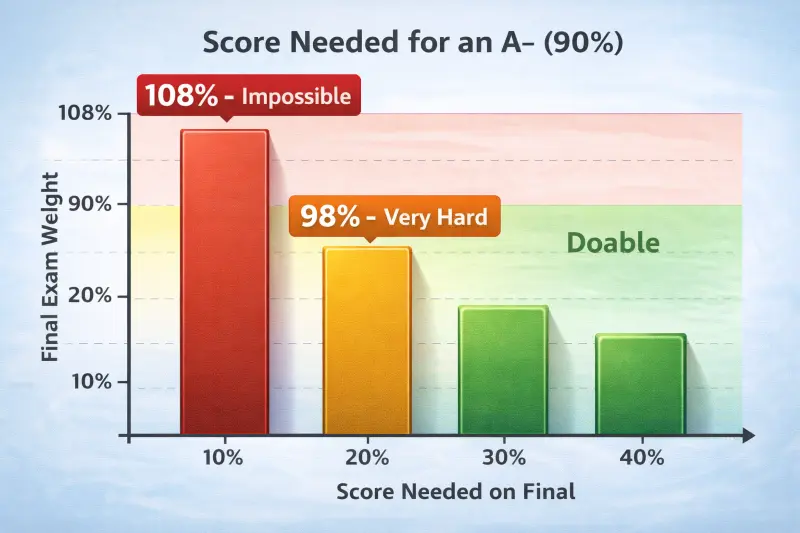
This chart visualizes the math. If your final exam is only worth 10% of your grade, it is mathematically impossible to raise an 88% to a 90%.
| Final Exam Weight | Score Needed for 90% (A-) | Score Needed for 80% (B-) |
|---|---|---|
| 10% | 108% (Impossible) | 8% (Safe) |
| 20% | 98% (Very Hard) | 48% (Safe) |
| 30% | 94% (Doable) | 61% (Safe) |
| 40% | 93% (Doable) | 68% (Safe) |
As you can see, a heavier final exam actually gives you more power to change your grade, for better or for worse.
How to Avoid Calculation Mistakes?
- Avoid these "GPA Traps" when planning your semester.
- Most students assume the number on their online dashboard is 100% accurate.
- But algorithms cannot read your syllabus.
Here are the three most common errors that inflate projected grades.
1. The "Canvas Trap" (Ghost Grades)
Learning Management Systems (LMS) like Canvas or Blackboard usually have a default setting: "Ignore Ungraded Assignments."
This is dangerous.
If you have missed 3 homework assignments, the system might not count them as zeros yet. It simply pretends they do not exist.
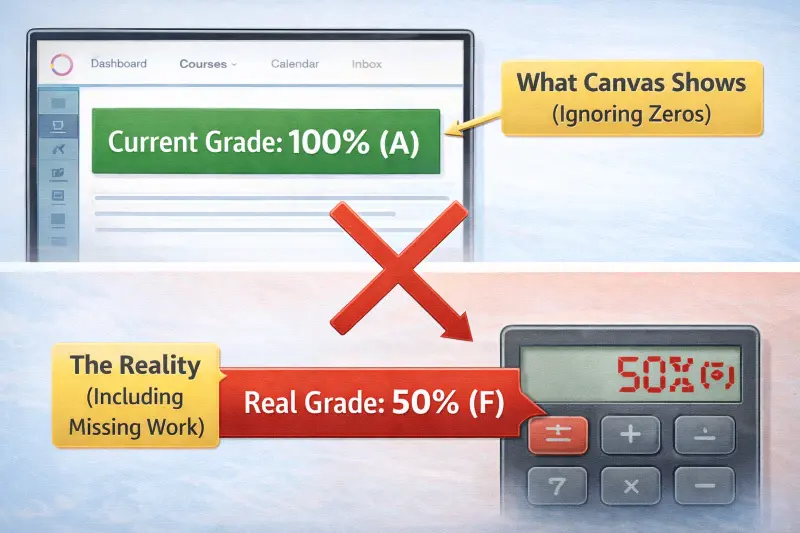
Don't trust the default view on Canvas or Blackboard. They often ignore missing assignments, making your grade look much higher than it actually is.
The Fix:
You must manually treat every "Missing" assignment as a 0%, or approximate assignment scores using What-If Grades.
| View | Calculation | Result |
|---|---|---|
| LMS Default | (100 + 100) / 2 Assignments | 100% (A) |
| Reality | (100 + 100 + 0 + 0) / 4 Assignments | 50% (F) |
2. Ignoring "Dropped" Grades
Many professors have a policy to drop the lowest score (e.g., "Best 4 out of 5 Quizzes").
Calculators are literal.
If you enter all 5 quiz grades, the calculator will average all of them, pulling your average down.
The Fix:
Find your lowest score. Delete it from the list. Only enter the grades that will actually count toward the final.
3. Confusing "Pass/Fail" (P/F)
Classes taken as Pass/Fail usually do not affect your GPA math.
- Pass (P): You get the credits, but 0 Quality Points. It does not raise or lower your GPA.
- Fail (F): In many schools, a Fail does count as a 0.0, which acts exactly like an "F" in a regular class.
The Rule:
Do not enter "Pass" grades into this calculator. They dilute the weight of your graded courses.
4. The "Incomplete" (I) Placeholder
An Incomplete is a temporary hold.
It allows you to finish coursework after the term ends.
The Risk:
If you do not finish the work by the deadline (usually 1 semester later), the "I" automatically converts to an "F" on your transcript.
We consistently observe students calculating their "target grade" based on the LMS default view, unaware that unsubmitted assignments are not yet factored into the average.
Frequently Asked Questions
What is considered a "Good" Semester GPA?
Generally, a 3.0 GPA (B Average) is the baseline for "Good Standing" at most universities.
However, the definition changes based on your goals:
- 2.0+: Required to avoid Academic Probation.
- 3.0+: Standard for maintaining financial aid.
- 3.5+: Usually qualifies you for the Dean's List.
- 3.8+: Competitive for Ivy League graduate programs.
Does a "W" (Withdrawal) hurt my Semester Grade?
No. When withdrawing from a course, the "W" carries 0.0 quality points and 0 credit hours.
It has absolutely no mathematical impact on your GPA calculation. It simply acts as a placeholder on your transcript to show you attempted the course.
Academic advisors frequently recommend taking a "W" rather than risking a "D" or "F," as the "W" protects the numerical average while the low grade permanently drags it down.
How do I calculate my grade if I haven't taken the final yet?
You need to calculate your "Current Weighted Average."
Take your average in each category (Homework, Quizzes, Tests) and multiply it by the weight of that category so far.
Do not divide by 100%. Divide by the total weight of graded assignments (e.g., 80%).
The Math:
Points Earned So Far ÷ Total Weight Completed = Current Grade
Can one bad semester ruin my Cumulative GPA?
It depends on your Total Credit Hours.
- Freshman: Yes. Since you have few credits, one bad term sets a low baseline.
- Senior: No. If you have 100+ credits, one bad semester is a drop in the ocean. The math makes it very hard to move your GPA up or down late in your degree.
What is the difference between Credit Hours and Contact Hours?
- Credit Hours are the value used for GPA math.
- Contact Hours are the actual hours you sit in a classroom.
Usually, they are 1:1.
However, in Lab Sciences, you might have 3 hours of lecture + 3 hours of lab (6 Contact Hours) but only receive 4 Credits. Always check your syllabus for the credit value.
How do I convert a percentage (e.g., 87%) to a 4.0 scale?
There is no universal federal standard. However, most universities follow this breakdown:
| Percentage | Letter | GPA |
|---|---|---|
| 93-100% | A | 4.0 |
| 90-92% | A- | 3.7 |
| 87-89% | B+ | 3.3 |
| 83-86% | B | 3.0 |
Do Freshman grades count toward my final GPA?
In the US and Canada, Yes. Your Freshman year is mathematically identical to your Senior year.
This differs from the UK or Australian systems, where the first year is often "Pass/Fail" or weighted less than the final two years.
What happens if I retake a class?
Most universities use a grade forgiveness policy (often called "Grade Replacement").
If you retake a class:
- 1The Old Grade remains on your transcript (for history).
- 2The New Grade replaces the old one in the GPA calculation.
- 3The Credits are only counted once.
Why is my GPA higher than 4.0?
You are likely using a Weighted Scale (High School). If you take AP or IB classes, your school adds bonus points (e.g., 5.0 for an A).
Colleges typically report GPA on a strict 4.0 scale, meaning the maximum possible unweighted GPA is 4.0.
Is a Semester GPA of 3.8 good for Harvard?
Yes, but with context. A 3.8 Semester GPA is strong. However, top-tier Ivy League schools look at the Cumulative GPA and the rigor of your courses. A 3.8 in difficult Engineering courses is often viewed more favorably than a 4.0 in easier Elective courses.