How to calculate your High School GPA
1: Choose Your GPA Type & Grade Format
Choose GPA Type first, by default weighted is selected but you can choose Unweighted if that's what you are looking for. Then select the Grade Format, you have two options here, Letter Grade and Percentage Grade Type, by default Letter Grades are selected.

2: Add Your Course names (optional)
You can enter the course name, it's optional, but to make it easy it has auto suggestions, so when you start typing the course name it will give you the suggestions.
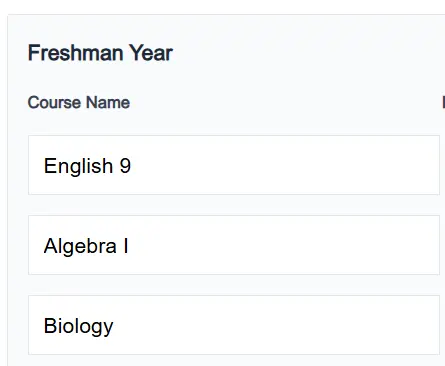
3. Course Details
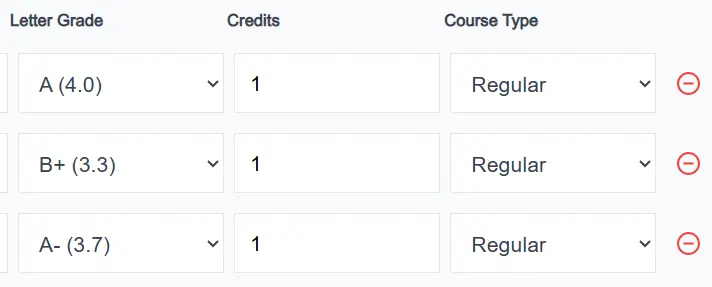
If you selected the Letter Grades from step 1 in grade format, you will see the letter grades. If you selected the percentage you will have Grade %. Choose the Letter Grade or enter the %. About Credits, since most schools use one credit, so by default it's 1, feel free to update it.
The final part is to choose/select the Course Type. It will show only if selected the Course Type Weighted. Options are Regular, Honors, AP, or IB.
4. Your GPA Results
You will see the result now. It's auto calculated so no need to click on button to get the results.
Even if you selected the Weighted or Unweighted we will show you both results. And with proper Letter Grade.
If you want to add another course or year. Since we gave three courses name option but you can add as many as you want.

Extra Features:
When you switch between Grade Formats, existing grades/data will convert.
All of your data is saved when you switch.
Add/Remove the Course by clicking on "-" icon on right side.
Add Year:
Add as many years as you want. If you are not a freshman, you should use it to get the full picture of your results. Remove the year by clicking on cross "X" icon from right side. If you want to start over, just click on the Reset Calculator button.

Detailed Course Breakdown:
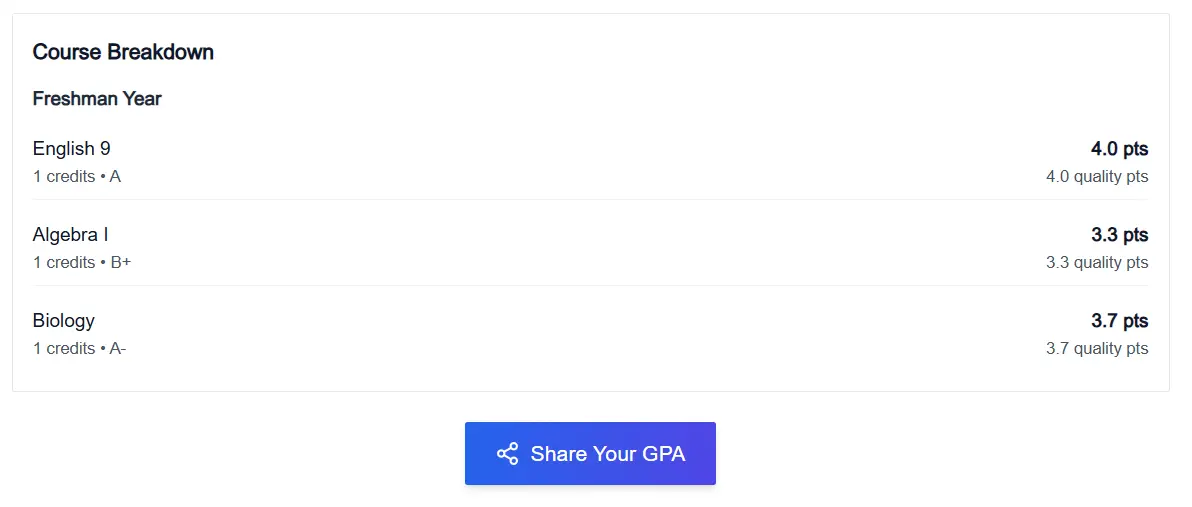
This is my favorite part. Here you can see the total GPA with Letter Grade and your Quality Points.
You can also find the status, based on your results, where you are standing in your academic.
Looks good? Share the result with your friends and parents. If you have any questions, share it with your teachers. Just click on the Share Your GPA. You will get unique URL to share. When someone opens that URL they don't need to add the details, it's already there.
What is a High School GPA?
It is the single most analyzed number in your young adult life. It determines where you go to college.
It influences the scholarships you win. It can even affect your first internship salary.
But here is the deal:
Most students (and parents) do not actually understand what a Grade Point Average (GPA) is.
They see a number like 3.6 or 4.2 on a transcript and accept it as fact. But that number is just the tip of the iceberg.

Your GPA looks like one simple number, but it is built from every single assignment you do over four years.
Your GPA is a mathematical summary of your academic performance over four years.
It is a calculation that converts every quiz, every late homework assignment, and every final exam into a standardized metric.
Think of it as your "Academic Credit Score."
Just like a credit score tells banks how reliable you are with money, your GPA tells admissions officers how reliable you are with intellectual rigor.
But there is a catch:
Not all GPAs are created equal.
A 4.0 at a high school in rural Kansas might not mean the same thing as a 4.0 at a prep school in New York City.
Why?
Because of the "Weighting Game." Some schools use a standard 4.0 scale.
Others use a 5.0 or even 6.0 scale. Some districts use a 100-point percentage system that never touches a decimal point until you apply to college. And then there are the colleges themselves.
Did you know that schools like UCLA, Stanford, and the University of Michigan often ignore the GPA on your transcript entirely?
It's true.
They take your raw grades and recalculate them using their own internal formulas to strip away "grade inflation."
In this exhaustive guide, I am going to walk you through every single variable of the High School GPA.
We will break down the math.
We will expose the hidden rules of "weighted" classes. And I will show you exactly how to calculate your score so you are never surprised by an admissions decision.
How to Calculate High School GPA (The Math/Formula)
Most people think calculating GPA requires advanced calculus.
It doesn't. It is actually simple arithmetic.
But to get it right, you have to stop thinking in "Letter Grades" and start thinking in "Quality Points." Here is the concept:
Every letter grade you earn is worth a specific amount of "currency."
- An A is worth gold (4 points).
- A C is worth copper (2 points).
To find your average, you cannot just add up the points.
You have to account for the "size" of the class.
This is where Credits come in.
The "Quality Points" Formula
The universal formula used by 98% of high schools and colleges is:
Total Quality Points ÷ Total Credit Hours = GPA
It sounds simple.
But let's break it down into a 4-step process so you can do it manually.
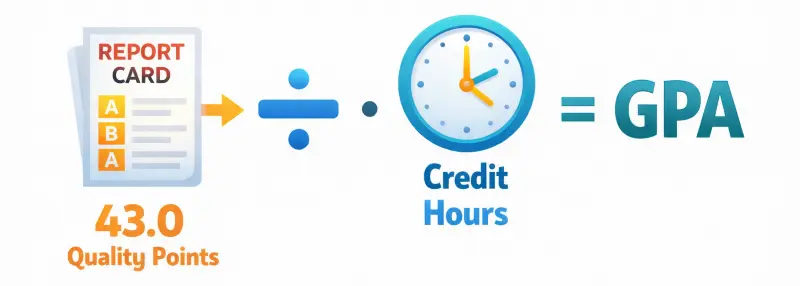
The secret to the math is dividing your Total Quality Points by your Total Credit Hours.
Step 1: Convert Letters to Points
First, take every letter grade on your report card and translate it into a number using the Standard 4.0 Scale (we will cover the full scale in the next section).
- A = 4.0
- B = 3.0
- C = 2.0
Step 2: Multiply by Credits
This is the step most students miss.
You must multiply the Grade Points by the Credit Hours for that specific class.
Why does this matter?
Because a grade in AP Biology (usually 1.0 credit) counts more than a grade in Gym (usually 0.5 credits).
If you get an "A" in Gym but an "F" in Biology, you don't have a "C" average. You have a "D" average.
Here is the math:
- Gym (0.5 Credits): Grade A (4.0) x 0.5 = 2.0 Quality Points
- Bio (1.0 Credits): Grade F (0.0) x 1.0 = 0.0 Quality Points
Total Points: 2.0
Total Credits: 1.5
GPA: 2.0 / 1.5 = 1.33 (Not 2.0)
Step 3: Tally the Totals
Add up all your "Quality Points" for the semester.
Then, add up all your "Credit Hours."
Step 4: Divide
Divide the Points by the Credits.
The resulting number, usually rounded to two decimal places, is your GPA.
The Calculation Table
To make this concrete, let's look at a realistic semester for a student named Alex.
| Class Name | Letter Grade | Base Points (4.0 Scale) | Credit Hours | Quality Points Calculation | Total Quality Points |
|---|---|---|---|---|---|
| English Lit | B+ | 3.3 | 1.0 | 3.3 x 1.0 | 3.3 |
| Algebra II | A- | 3.7 | 1.0 | 3.7 x 1.0 | 3.7 |
| World History | B | 3.0 | 1.0 | 3.0 x 1.0 | 3.0 |
| Physical Ed. | A | 4.0 | 0.5 | 4.0 x 0.5 | 2.0 |
| Chemistry | C+ | 2.3 | 1.0 | 2.3 x 1.0 | 2.3 |
| Art I | A | 4.0 | 0.5 | 4.0 x 0.5 | 2.0 |
| TOTALS | 5.0 | 16.3 |
Now, we run the formula:
16.3 (Quality Points) ÷ 5.0 (Credits) = 3.26 GPA
Alex has a 3.26 GPA for this semester.
If Alex had ignored the credits and just averaged the grade points (3.3 + 3.7 + 3.0 + 4.0 + 2.3 + 4.0) / 6, he would have calculated a 3.38.
That is a significant difference.
And when you are applying to competitive colleges, a difference of 0.12 can be the deciding factor.
The Standard 4.0 Scale: The Rosetta Stone of Grades
Before you can calculate anything, you need the official conversion chart.
This is the "Rosetta Stone" that translates the alphabet into arithmetic.
While some schools have unique quirks, the vast majority of US High Schools use the College Board Standard 4.0 Scale.
You need to memorize this.
Or better yet, bookmark this page.
Here is exactly how the conversion works:
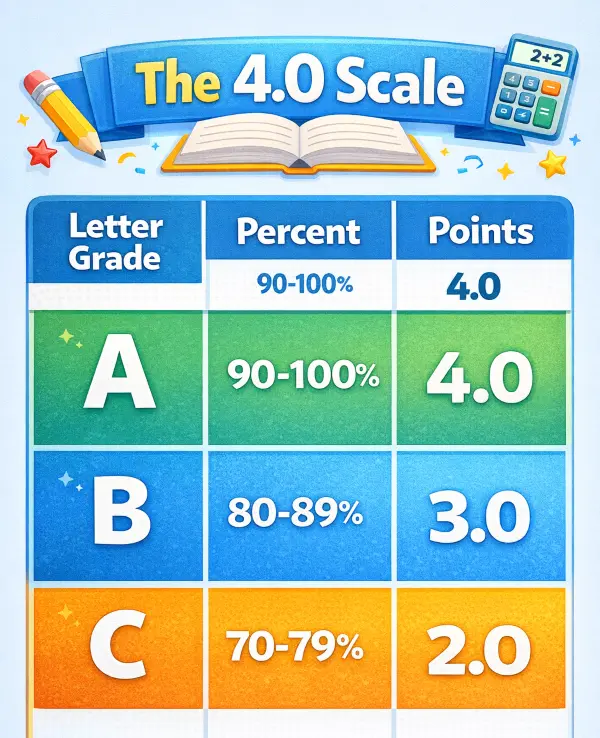
Bookmark this chart. You will need it to convert every letter grade on your report card into a number.
| Letter Grade | Percentage Range | Unweighted GPA Points |
|---|---|---|
| A+ | 97 – 100% | 4.0 (or 4.3) |
| A | 93 – 96% | 4.0 |
| A- | 90 – 92% | 3.7 |
| B+ | 87 – 89% | 3.3 |
| B | 83 – 86% | 3.0 |
| B- | 80 – 82% | 2.7 |
| C+ | 77 – 79% | 2.3 |
| C | 73 – 76% | 2.0 |
| C- | 70 – 72% | 1.7 |
| D+ | 67 – 69% | 1.3 |
| D | 65 – 66% | 1.0 |
| F | Below 65% | 0.0 |
The "A+" Controversy
You will notice a discrepancy in the first row.
Some schools count an A+ as a 4.3.
This allows students to theoretically achieve higher than a 4.0 without taking weighted classes.
However, most colleges, and the Common Application, cap the unweighted scale at 4.0.
This means that even if you get a 100% in AP Calculus, it counts the same as a 93% in the eyes of the unweighted scale.
This is why many Valedictorians don't actually have the highest "grades" in the class. They just have the highest "optimized" GPA.
The "Minus" Trap
Pay close attention to the Minus Grades.
An A- is a 3.7.
That is a huge drop from a 4.0.
I have seen students with straight A- grades (all 90% to 92%) end up with a 3.7 GPA.
Meanwhile, a student with a mix of A's (93%) and B's (85%) might actually end up with a similar GPA.
This is why "grade grubbing" for that extra 1% to push a 92% to a 93% is actually mathematically rational.
That single percentage point is worth 0.3 GPA points for that class.
Weighted vs. Unweighted GPA
This is the source of 90% of the confusion surrounding GPAs.
You often hear students say things like:
"I have a 4.8 GPA."
But if the scale stops at 4.0, how is that possible?
The answer lies in Weighted GPA.
Unweighted GPA: The Raw Performance
Unweighted GPA treats every class exactly the same.
It measures purely your performance, ignoring the difficulty of the task.
- An "A" in Remedial English = 4.0
- An "A" in AP English Literature = 4.0
This metric tells colleges how well you executed your assignments.
But it doesn't tell them if you challenged yourself.
Weighted GPA: The Rigor Metric
Weighted GPA adds "Bonus Points" to difficult classes.
It is designed to reward students who take risks.
If you take a harder class, the school gives you a handicap.
Here is the standard "Weighting" breakdown used by most US districts:
| Course Difficulty Level | Bonus Added | New "A" Value | New "B" Value |
|---|---|---|---|
| Regular / College Prep | +0.0 | 4.0 | 3.0 |
| Honors | +0.5 | 4.5 | 3.5 |
| AP / IB / Dual Enrollment | +1.0 | 5.0 | 4.0 |
Why This Changes Everything
Let's look at a comparative scenario.
Imagine two students, Student Easy and Student Hard.
Student Easy wants to protect their GPA, so they take standard classes.
Student Hard wants to challenge themselves, so they take AP classes.
Student Easy's Schedule:
- Standard English: A (4.0)
- Standard Math: A (4.0)
- Standard History: A (4.0)
- GPA: 4.0
Student Hard's Schedule:
- AP English: B (3.0 Base + 1.0 Bonus = 4.0)
- AP Calculus: B (3.0 Base + 1.0 Bonus = 4.0)
- AP US History: B (3.0 Base + 1.0 Bonus = 4.0)
- GPA: 4.0
Do you see what happened?
Student Hard got all B's, but ended up with the same Weighted GPA as Student Easy who got all A's.
This is the purpose of the weighted system.
It allows you to get a "B" in a hard class without destroying your class rank.
However, colleges look at BOTH numbers.
If you have a high Weighted GPA but a low Unweighted GPA (lots of weighted B's and C's), they might worry that you are overstretching yourself.
If you have a perfect Unweighted GPA but a low Weighted GPA (no AP classes), they might think you are "coasting."
The "Goldilocks" zone is a high Unweighted GPA and a high Weighted GPA.
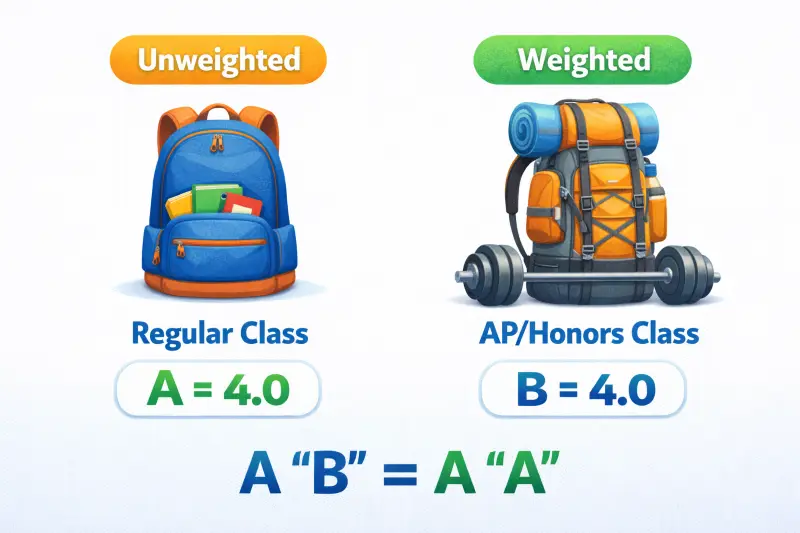
In a weighted system, a "B" in a difficult AP class is often worth the same amount of points as an "A" in a standard class.
The Impact of AP, IB, and Honors Classes
If you are aiming for a Top 50 university, you need to understand the hierarchy of course rigor.
Not all "hard" classes are treated equally by the calculator.
Advanced Placement (AP)
These are the gold standard for weighting in the US.
Because the curriculum is standardized by the College Board, admissions officers know exactly what an "AP" label means.
- Weight: Usually +1.0 (Full Point).
- Scale: 5.0 Scale.
International Baccalaureate (IB)
IB is often considered even more rigorous than AP due to the required essays and holistic structure.
However, for GPA calculation purposes, it is usually treated the same as AP.
- Weight: Usually +1.0 (Full Point).
- Scale: 5.0 Scale.
- Nuance: Some schools distinguish between IB SL (Standard Level) and IB HL (Higher Level), giving more weight to HL. Check your handbook.
Honors Classes
These are "Advanced" but not "College Level."
They move faster than standard classes but don't result in college credit.
- Weight: Usually +0.5 (Half Point).
- Scale: 4.5 Scale.
- Warning: Some high schools inflate this to +1.0, but colleges will often strip that extra bonus away during recalculation.
Dual Enrollment (DE)
This is when you take actual college classes at a local community college or university.
- Weight: This varies wildly by state.
- Florida & California: Often treated exactly like AP (+1.0).
- Other States: Sometimes treated as unweighted (4.0) but look great on a transcript.
- The Best Part? You earn actual college transcript credits, which transfer more easily than AP scores in many cases.
The "Hidden" Variables: Credits and Terms
We mentioned credits earlier, but we need to go deeper.
The single biggest mistake I see in manual GPA calculation is ignoring the Credit Variance.
The "Lab Science" Trap
In many high schools, a science class like Chemistry or Physics includes a "Lab Period."
This often means the class meets for 1.5 periods a day or has an extra session.
Because of this, some schools assign 1.25 or 1.5 credits to these classes.
If you Ace Physics (1.5 credits), it boosts your GPA significantly more than Acing History (1.0 credit).
Always check your transcript for the "Credits Earned" column. Do not assume everything is 1.0.
Semester vs. Trimester vs. Quarter
The math changes slightly depending on your school's calendar.
Semester System (Most Common):
- 2 Grading Periods per year.
- Each semester grade stands alone in the calculation.
- Total Entries per Year: 6 classes x 2 semesters = 12 grades.
Trimester System:
- 3 Grading Periods per year.
- Classes might change every 12 weeks.
- Total Entries per Year: 5 classes x 3 trimesters = 15 grades.
- Impact: One bad trimester grade hurts less than one bad semester grade because it is a smaller fraction of the total.
Quarter/Term System:
- 4 Grading Periods per year.
- Usually, the Quarter grades are averaged to create a Semester Grade, and only the Semester Grade goes on the final transcript.
- Crucial Note: Check if your school averages the percentages or the points.
- Averaging Points: (A + B) / 2 = 3.5 GPA.
- Averaging Percent: (93% + 86%) / 2 = 89.5% → A- (3.7 GPA).
- In this case, averaging the percentage saved your GPA!
Cumulative vs. Semester GPA
You have two GPAs.
Admissions officers care about one. You usually stress about the other.
1. Semester GPA
This is your GPA for the Current Term.
It tells you how you did just now.
It is useful for:
- Honor Roll eligibility.
- Sports eligibility (NCAA requires a minimum term GPA in some cases).
- Parental rewards/punishments.
2. Cumulative GPA
This is the average of every grade you have earned since Day 1 of Freshman Year.
This is the number that goes to colleges.
The "Math Anchor" Effect:
As you get older, your Cumulative GPA becomes harder to move.
Think of it like a bathtub.
- Freshman Year: The tub is empty. One bucket of hot water (good grades) makes the whole tub hot.
- Senior Year: The tub is full. One bucket of cold water (bad grades) barely changes the temperature.
Example of the Anchor Effect:
- Freshman Year: 3.0 GPA (6 classes). Cumulative: 3.0.
- Sophomore Year: 4.0 GPA (6 classes). Cumulative: 3.5.
- Junior Year: 4.0 GPA (6 classes). Cumulative: 3.66.
- Senior Fall: 4.0 GPA (6 classes). Cumulative: 3.75.
Even with three straight years of perfect grades, the student could not reach a 3.8.
That Freshman year 3.0 acts as a heavy anchor.
This is why Freshman year is arguably the most important year for GPA management. It sets the mathematical foundation.
Regional Variations & Policy
The US education system is decentralized.
This means a student in Texas plays by different rules than a student in South Carolina.
Here are some specific regional systems you need to know about.
1. The Texas "Top 10% Rule"
In Texas, if you graduate in the top 10% of your class (at public high schools), you get automatic admission to most state funded universities (like Texas A&M).
- UT Austin Exception: They are so competitive that the cutoff is usually top 6%.
- The Strategy: In Texas, Class Rank matters more than the raw GPA number. Students often choose classes strategically to maximize weighted points to inch up the rank, even if they don't care about the subject.
2. The South Carolina Uniform Grading Policy (UGP)
South Carolina uses a very specific, mandated scale for all public schools to ensure fairness for state scholarships (like the LIFE Scholarship).
- They convert every numerical grade (0-100) directly into a GPA point value.
- Formula: It is roughly: (Grade - 61) / 10 for passing grades, but they have a massive lookup table.
- Example: A 100 in an Honors class is worth 5.500. A 100 in AP is worth 6.000.
- This system is incredibly precise. A 94 is worth more than a 93.
3. The California (UC) "A-G" Calculation
The University of California system (UCLA, Berkeley, UCSD) does not look at your transcript GPA.
They calculate their own "UC GPA."
- Rule 1: They only count "A-G" courses (History, English, Math, Science, Language, Arts, Electives). PE does not count.
- Rule 2: They DO NOT count Freshman year grades. They only look at 10th and 11th grade for the GPA calculation (though they see the 9th grade courses).
- Rule 3: They cap the number of extra honors points. You can only get credit for 8 semesters of weighted work (4 classes).
- This prevents students from inflating their GPA by taking 15 AP classes. The cap levels the playing field.
4. New York & The 100-Point Scale
Many East Coast schools, especially in NY and NJ, don't use a 4.0 scale at all.
They report a Weighted Average out of 100.
- Transcript: "94.564"
- Calculation: They simply average the percentages.
- Weighting: They might multiply the grade by 1.05 or 1.10 before averaging.
- Example: 90 in AP Bio x 1.10 = 99.0 for the average.
How Colleges *Really* Recalculate Your GPA
I touched on this with the UC system, but it applies everywhere.
Admissions officers know that High School A offers 20 AP classes and High School B offers 2.
They know that High School C gives A's to everyone (Grade Inflation) and High School D is rigorous.
To handle this, they perform a "Holistic Review" and often a "Recalculation."
The "Core GPA" Method
Most colleges strip your transcript down to the studs.
They remove:
- Gym / Health
- Religious Instruction
- Office Aide / Teacher Assistant
- Woodshop / Cooking (unless it is a specific technical college)
- Band / Orchestra (sometimes kept, sometimes removed depending on the major)
They then recalculate the GPA using only the Core 5 Subjects:
- 1English
- 2Math
- 3Science
- 4Social Studies
- 5Foreign Language
Why does this matter?
If you have a 3.8 GPA because you got A's in Choir, Pottery, and Gym, but B's in Math and English, your "College GPA" might drop to a 3.4.
Colleges will see right through the "fluff."
The "School Profile" Sheet
Every high school sends a "School Profile" document along with your transcript.
This document tells the college:
- How many AP classes are offered.
- How weighted GPA is calculated.
- The average GPA of the graduating class.
If you have a 3.5 GPA, that sounds average.
But if the School Profile says the average GPA at your rigorous prep school is a 2.8, suddenly your 3.5 looks incredible.
Context is everything.
Strategies for GPA Improvement
So, you calculated your GPA and you don't like the number.
Is it too late?
Not necessarily.
But you need a mathematical strategy.
1. The "Retake" Loophole
Check your school's policy on Grade Forgiveness.
Some schools allow you to retake a class you failed (or got a D in) over the summer.
- Scenario A (Averaging): Old Grade (F) + New Grade (A) = Average (C).
- Scenario B (Replacement): Old Grade (F) is hidden. New Grade (A) is the only one calculated.
- Effect: This is the single most powerful way to raise a GPA. Replacing a 0.0 with a 4.0 shifts the average massively.
2. The "Upward Trend" Narrative
If you can't fix the math, fix the story.
Colleges love a comeback story.
A student with this trend:
- 9th: 2.5
- 10th: 3.0
- 11th: 3.8
Is often viewed more favorably than a student with:
- 9th: 3.8
- 10th: 3.0
- 11th: 2.5
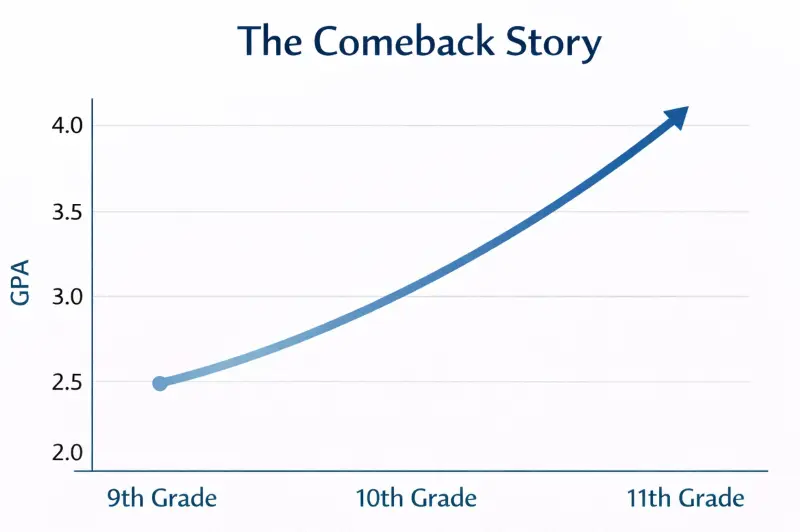
Colleges prefer to see your grades go up over time rather than down. This graph shows a positive "upward trend."
The first student is "maturing." The second student is "burning out."
If you had a bad Freshman year, write about it in the "Additional Information" section of the Common App. Explain why (illness, family trouble, maturity) and point to your recent grades as the "real" you.
3. Strategic Drop/Add
If you are in a class where you are drowning (getting a D or F) and it is before the withdrawal deadline... DROP IT.
A "W" (Withdrawal) on a transcript looks infinitely better than an "F."
A "W" does not affect your GPA.
An "F" destroys it.
Better to take a "W" and retake the class later than to dig a hole you can't climb out of.
Common Calculation Mistakes & Hidden Rules
I have audited hundreds of student-calculated GPAs.
The same errors pop up every time.
1. The "Quarter Grade" Confusion
Mistake: Including Q1 and Q2 grades in the annual calculation.
Reality: Only the Final Semester Grade usually carries credit.
If you got an A in Q1 and a C in Q2, but ace the final and get a B+ for the semester... only the B+ (3.3) goes into the GPA math. The Q1 and Q2 are just progress reports.
2. Mixing Scales
Mistake: Adding 5.0 for an AP class but dividing by the total count on a 4.0 scale.
Reality: You must choose your lane.
- Unweighted Calculation: Treat everything as max 4.0.
- Weighted Calculation: Treat APs as 5.0.
- Do not mix them unless you want a number that means nothing to nobody.
3. Forgetting "Failures"
Mistake: Ignoring an "F" because you didn't get credit.
Reality: This is the most dangerous myth.
If you fail a class, you get 0.0 Quality Points.
BUT... you still attempted the Credit Hours.
So the denominator grows (credits attempted) but the numerator (points) does not.
This dilutes your average severely.
- Note: Some schools list "Credits Attempted" vs "Credits Earned." GPA uses Credits Attempted.
Frequently Asked Questions (FAQ)
Do colleges look at Weighted or Unweighted GPA?
They look at everything.
They use the Unweighted GPA to judge your baseline competence.
They use the Weighted GPA (and the list of classes taken) to judge your ambition and "Rigor of Schedule."
A 4.0 Unweighted with zero AP classes is often seen as "safe" but not "competitive" for Ivy League schools.
What is the highest possible GPA?
It depends on the school's policy.
- Unweighted: 4.0 is the hard cap.
- Weighted: Theoretically, 5.0 (if you took ONLY AP classes).
- Reality: Because of mandatory unweighted classes (Gym, Health, Arts), the valedictorian at a competitive high school usually has a weighted GPA around 4.6 to 4.8.
- South Carolina: Students can have GPAs over 5.0 because of their specific 6.0 scale.
Is a 3.5 GPA good?
Yes, it is above the national average.
A 3.5 (roughly a mix of A's and B's) makes you a strong candidate for 85% of colleges in the US, including many excellent State Universities (like Penn State, Michigan State, Texas Tech).
It is usually not competitive for "Top 20" schools without extraordinary extracurriculars (like being an Olympic athlete).
Does Freshman year really matter?
Yes, mathematically.
Your cumulative GPA includes 9th grade. A 2.0 in 9th grade will pull down your average for all four years.
However, Stanford and the University of California (UC) system famously exclude 9th-grade grades from their specific GPA recalculations. They view 9th grade as a "transition year."
How do I convert a 4.0 GPA to a percentage?
It is an estimate, not a direct conversion.
- 4.0 ≈ 93-100%
- 3.5 ≈ 88-92%
- 3.0 ≈ 83-87%
- 2.0 ≈ 73-77%
Use the table provided in the "Standard 4.0 Scale" section for precision.
What happens if I move schools?
Your new school will "translate" your transcript.
If you move from a school with a 5.0 scale to a school with a 4.0 scale, your new guidance counselor will manually convert your old grades to the new system.
This can sometimes result in a GPA drop (or bump) depending on how generous the new school's conversion chart is.
Can I get into college with a 2.5 GPA?
Absolutely.
While Ivy Leagues are off the table, hundreds of colleges accept students with a 2.5 GPA.
Search for "Open Enrollment" colleges or "Regional State Universities."
Community College is also a fantastic option: maintain a 3.5+ there for two years, and you can transfer to a top-tier university, leaving your high school GPA behind forever.