What is College Grade Point Average (GPA)?
Grade Point Average (GPA) is critical for academic success (college). Whether you are applying to college, aiming for the Dean's List, or just trying to pass a difficult semester, you need accurate data, not guesses.
GPA Calculator is designed to handle every grading scenario. From standard high school GPA calculations to complex weighted college transcripts with AP or Honors classes, our calculator will provide you the exact numbers you need to track your academic progress.
How to Use the GPA Calculator
Follow these easy steps to calculate your college GPA.
1: Select Mode (Weighted or Unweighted)
- Unweighted: Choose this if your school uses a standard scale where an "A" is always 4.0, regardless of the class difficulty. This is common for middle school and many colleges.
- Weighted: Choose this if you are taking advanced classes (AP, Honors, IB). This mode unlocks the "Course Type" dropdown, allowing you to apply 5.0 or 6.0 weighting scales.
2: Enter Course Details
- Course Name: Enter the class title (e.g., "Chemistry").
- Grade: Select your letter grade from the dropdown.
- Credits: Enter the credit hours. For high school, a standard year-long class is usually 1 credit. For college, a standard class is usually 3 or 4 credits. (If you are unsure of your current class percentage, use our main Grade Calculator to find your exact course average first).
- Course Type (Weighted Mode Only): Select "Regular," "Honors" (+0.5 points), or "AP/IB" (+1.0 points).
3: Analyze the Results
After adding all the info you will see:
- Semester GPA: Your average for just the current list of classes.
- Cumulative GPA: Your overall average across all added semesters.
Features of College GPA Calculator
We built this tool to replace complex spreadsheets and manual math. Here is how it helps you:
- Weighted & Unweighted Support: Instantly switch between standard calculations (4.0 scale) and weighted calculations that give bonus points for AP, IB, or Honors courses. (Not sure which one to use for college apps? Read our guide on Weighted vs. Unweighted GPA).
- Multi-Semester Tracking: Don't just calculate one term. Add multiple semesters to see your full Cumulative GPA.
- Quality Points Transparency: We show you exactly how many "Quality Points" each class contributes to your score, helping you understand which grades impact your average the most.
- Smart Course Detection: Start typing "Algebra" or "English," and our system auto-fills common course names to save you time.
- 4.0 Scale Conversion: Input your letter grades (A-, B+), and we automatically convert them to the standard 4.0 scale used by most universities.
Understanding Your Results
The output gives you three key metrics. Here is what they mean:
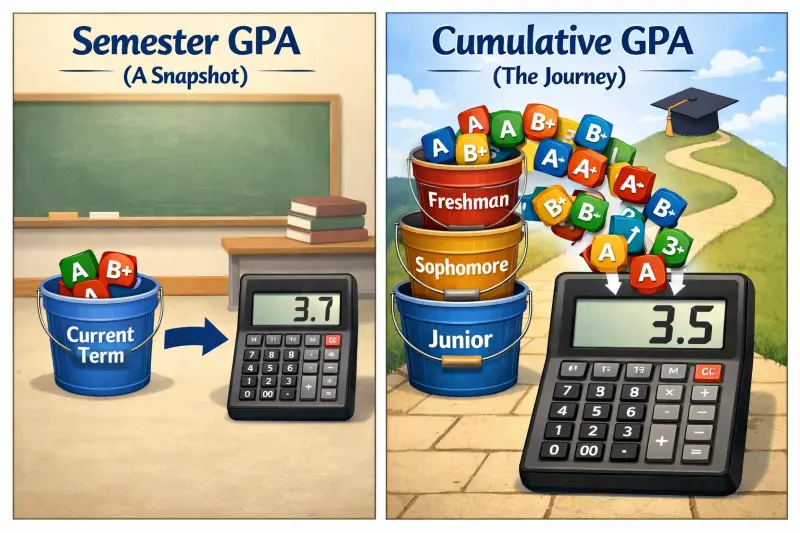
1. Semester GPA vs. Cumulative GPA
Your Semester GPA measures your performance in a single term (e.g., Fall 2025). Your Cumulative GPA is the average of all semesters combined. Colleges look at your Cumulative GPA for admission, while academic probation is often decided by your Semester GPA.
2. Total Quality Points
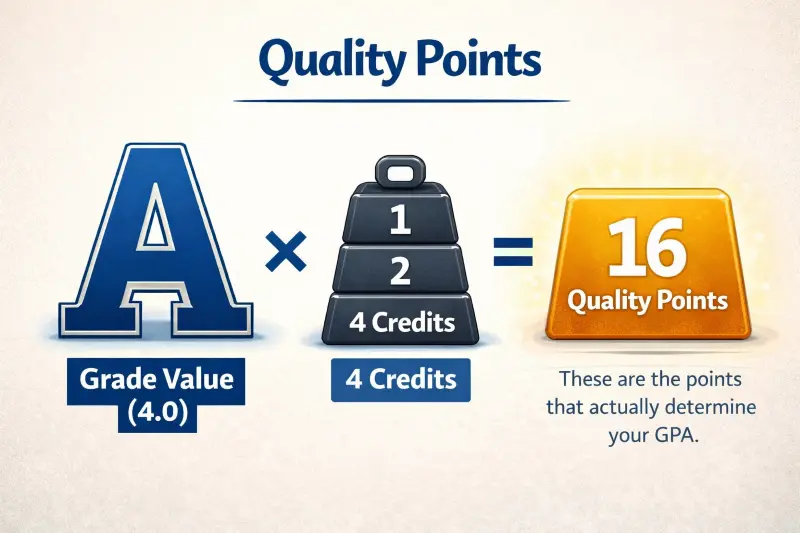
This is the raw "score" of your academic career. It is calculated by multiplying your grade points by your credits.
Example: An "A" (4.0) in a 3-credit class = 12 Quality Points.
3. Academic Standing
Our tool displays a status bar indicating if your GPA falls into "Excellent," "Good," or "Average" ranges based on national data.
- 3.5 - 4.0: typically Dean's List / Honors.
- 3.0 - 3.4: Good Standing.
- Below 2.0: Often Academic Probation.
Grading Systems: How Universities Calculate GPA
While most schools use the standard 4.0 scale, variations exist. It is important to know which system your institution uses.
The Standard 4.0 Scale
This is the most common system used by the vast majority of institutions, including Ohio State University (OSU) and Purdue University.
- A = 4.0
- B = 3.0
- C = 2.0
- D = 1.0
- F = 0.0
The "Plus/Minus" System
Many competitive universities, such as the University of Florida (UF) and the University of North Carolina (UNC), use a plus/minus system to be more precise. In this system, an "A-" is a 3.7, and a "B+" is a 3.3. Our calculator uses this system by default for maximum accuracy.
University of California (UC) GPA
The UC GPA Calculator method (used by UCLA, UC Berkeley, etc.) has specific rules:
- They cap the number of weighted honors credits you can count (usually 8 semesters).
- They calculate GPA using only 10th and 11th-grade marks for admission ("A-G courses").
Law School Admission Council (LSAC)
The LSAC GPA Calculator standardizes grades for law school admissions. Uniquely, they count an "A+" as a 4.33, meaning it is possible to have a GPA higher than 4.0 without weighted classes.
Grading Scale Reference Tables
Use these charts to convert your percentage or letter grades into GPA points.
1. Standard 4.0 Scale (Unweighted)
| Letter Grade | Percentage Range | GPA Points |
|---|---|---|
| A / A+ | 93 - 100% | 4.0 |
| A- | 90 - 92% | 3.7 |
| B+ | 87 - 89% | 3.3 |
| B | 83 - 86% | 3.0 |
| B- | 80 - 82% | 2.7 |
| C+ | 77 - 79% | 2.3 |
| C | 73 - 76% | 2.0 |
| C- | 70 - 72% | 1.7 |
| D | 60 - 69% | 1.0 |
| F | Below 60% | 0.0 |
2. Weighted Scale (High School AP/Honors)
| Letter Grade | Regular Class | Honors Class (+0.5) | AP / IB Class (+1.0) |
|---|---|---|---|
| A | 4.0 | 4.5 | 5.0 |
| B | 3.0 | 3.5 | 4.0 |
| C | 2.0 | 2.5 | 3.0 |
| D | 1.0 | 1.5 | 2.0 |
| F | 0.0 | 0.0 | 0.0 |
University-Specific GPA Scales
While most colleges use the standard 4.0 scale, many top universities use their own unique systems. Here is a quick reference guide for some of the most popular schools.
(Don't see your specific grading system here? Check our FAQ to learn how to handle unique university scales.)
| University | System Type | Key Details |
|---|---|---|
| University of Florida (UF) | Plus/Minus | Uses precise points (A- = 3.67, B+ = 3.33). Counts failing grades (E) as 0.0. |
| Rutgers University | Standard 4.0 | Undergraduate programs do not use "minus" grades. Grades are A, B+, B, C+, C, D, F. |
| Arizona State (ASU) | Plus/Minus | An A+ is worth 4.33. However, the official cumulative GPA is capped at 4.00. |
| UW Madison | Standard 4.0 | Uses A, AB (3.5), B, BC (2.5), C, D, F. No "plus/minus" system. |
| Ohio State (OSU) | Standard 4.0 | Uses standard letter grades. A failing letter grade (E) counts as 0.0. (Note: "U" grades are generally excluded from GPA). |
| Univ. of Texas (UT) | Plus/Minus | Uses standard plus/minus. Note: The university does not award an A+ grade for undergraduate studies. |
| Univ. of California (UC) | A-G Courses | Only counts grades from 10th and 11th grade for admission. Caps honors points. |
Our Best 4 Tips to Raise Your GPA
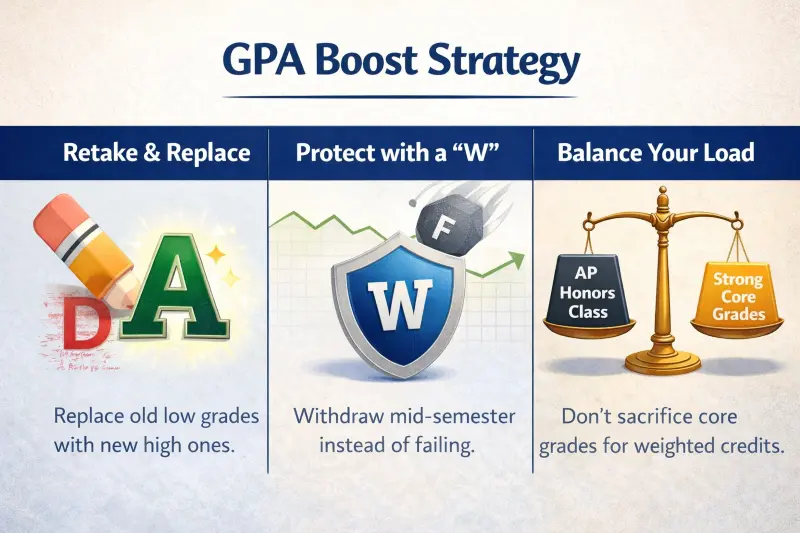
If your calculated GPA isn't where you want it to be, use these strategies:
1. Retake Classes
Check your school's "Grade Replacement" policy. Retaking a "D" or "F" class can drastically repair a damaged GPA if the new grade replaces the old one entirely.
2. Protect Your "W"s
If you are failing a course mid-semester, withdrawing (W) is often better than taking an "F". A "W" usually has zero impact on your GPA.
3. Balance Your Load
Don't overload on AP/Honors classes if it risks your core grades. A weighted "B" (4.0) is often better than a weighted "C" (3.0), but a standard "A" (4.0) looks better than a weighted "D" (2.0). Use our Final Grade Calculator to see exactly what scores you need on upcoming exams to save your GPA.
4. Check for Curves
Don't panic over a low raw score. Many professors adjust difficult exams. Use our Grade Curve Calculator to see if your 70% might actually be a B+ after a class adjustment.
Frequently Asked Questions About College GPA
How do I calculate my high school GPA without credits?
If your school doesn't assign credits (or every class is worth the same), simply leave the "Credits" field as "1" for every course. The calculator will then determine your average based purely on your letter grades.
What are "Credits" in a GPA calculator?
Credits (or credit hours) represent the "weight" or time value of a class.
- High School: Usually, a year-long class is 1.0 credit, and a semester class is 0.5 credits.
- College: A standard lecture course is often 3 credits, while a lab science might be 4 credits. A 4-credit "A" boosts your GPA much more than a 1-credit "A".
What is the difference between Semester GPA and Cumulative GPA?
- Semester GPA: This is your average for a single academic term (e.g., Fall 2024). It determines your eligibility for the Dean's List or academic probation for that specific term.
- Cumulative GPA: This is the average of all classes you have taken throughout your entire high school or college career. This is the number colleges and employers typically look at.
How do I calculate my Cumulative GPA manually?
To calculate it yourself, follow this formula: Total Quality Points ÷ Total Credit Hours = GPA
First, multiply each grade's point value (e.g., A=4) by the class credits to get "Quality Points." Sum up all your quality points and divide that number by the total number of credits you attempted.
Is a 93% always a 4.0?
In most standard US systems, yes. However, some grading scales require a 94% or 95% for a solid 4.0. Always check your specific school's student handbook to confirm their cutoff points. (Also, check if your professor uses a Grade Curve to adjust these cutoffs based on class performance).
Why is my Weighted GPA higher than 4.0?
A Weighted GPA accounts for the difficulty of your coursework. If you take Advanced Placement (AP), International Baccalaureate (IB), or Honors classes, schools often add a "bonus" (usually +0.5 or +1.0) to your grade points. This means an "A" in an AP class could count as a 5.0, allowing your total average to exceed the standard 4.0 limit.
Does a "Pass/Fail" or "W" (Withdrawal) class affect my GPA?
Usually, no.
- Pass (P) / Credit (CR): Counts toward graduation requirements but is excluded from the GPA calculation.
- Withdrawal (W): Generally has no impact on your GPA, although too many "W"s can sometimes look concerning on a transcript.
- Fail (F): Does impact your GPA and is calculated as a 0.0.
How do I convert a UK percentage to US GPA?
The systems are very different. Generally:
- 70% + (First Class) ≈ 4.0 GPA
- 60-69% (Upper Second) ≈ 3.3 - 3.7 GPA
- 50-59% (Lower Second) ≈ 2.7 - 3.0 GPA
If I retake a class, will my GPA go up?
It depends on your school's policy. Many colleges offer "Grade Replacement," where the new, higher grade replaces the old "F" or "D" in your GPA calculation (though the old grade often remains visible on the transcript). If your school averages the two attempts, your GPA will improve, but less dramatically.
What is a good GPA in middle school?
A 3.0 GPA (B average) is generally considered good in middle school. It indicates you are grasping the core material. High-performing students aiming for Honors tracks in high school typically aim for a 3.5 or higher.